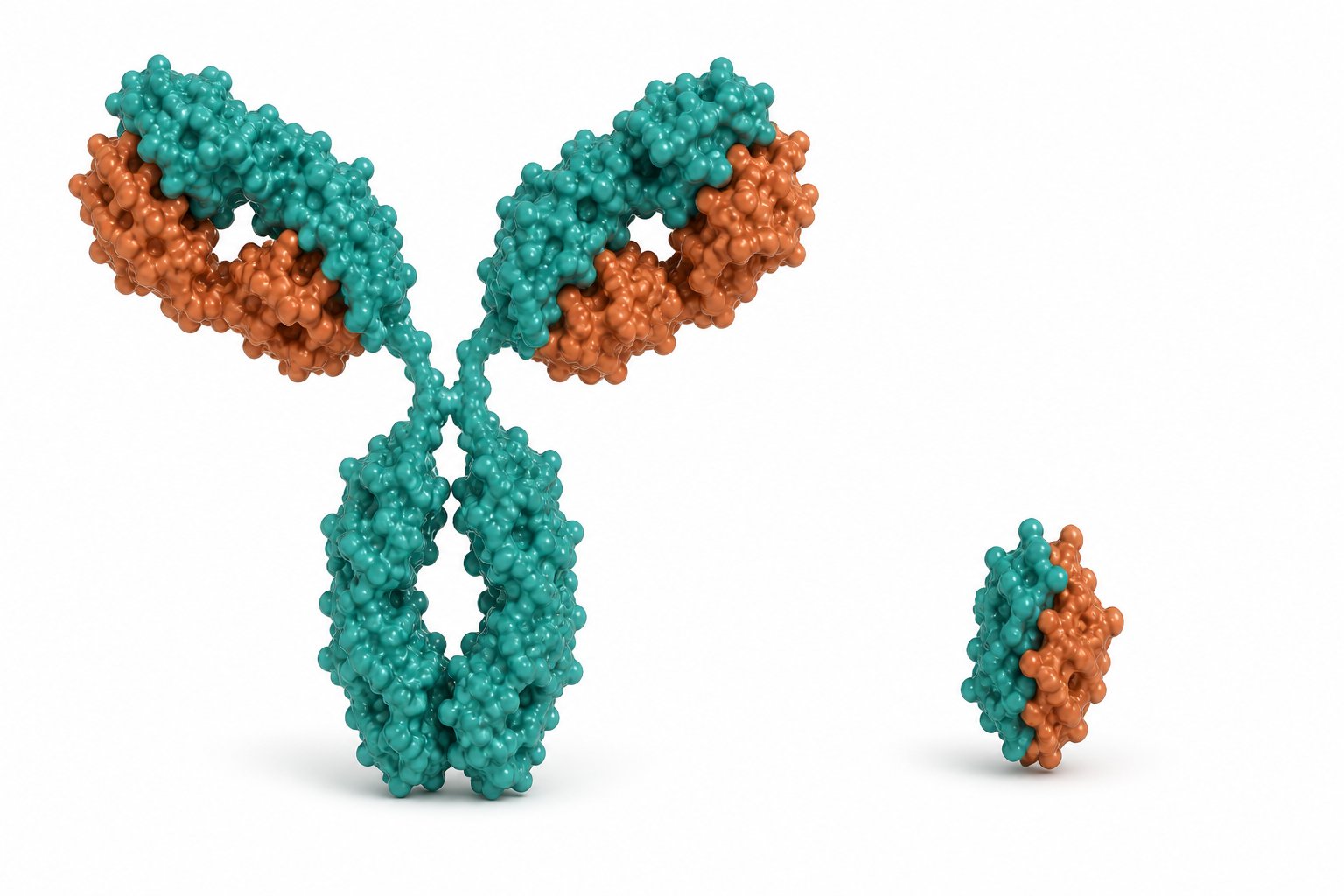
Antibody therapeutics have long been treated as finished products: large, Y-shaped proteins selected for affinity and then formulated for infusion. Materials scientists look at the same molecules differently. An immunoglobulin G (IgG) is a roughly 150 kilodalton assembly of four polypeptide chains. That architecture is powerful, but it is also bulky, disulfide-rich, and poorly suited to many intracellular surfaces. In 2026, a growing share of biologic design work is asking a materials question rather than a purely pharmacological one: what happens if the binding domain is isolated, miniaturized, and treated as an engineered fragment instead of a full antibody?
Nanobodies answer that question with a single immunoglobulin domain. They are not miniature copies of IgG. They are single-domain antibody fragments, typically the variable heavy domain of camelid heavy-chain-only antibodies, often called VHH. At roughly 12 to 15 kilodaltons they are about one-tenth the mass of a conventional monoclonal antibody, small enough to change diffusion, tissue access, thermal behavior, and manufacturing assumptions. For materials groups, they look less like a slogan and more like a compact, programmable protein.
A single-domain fold, not a scaled-down IgG
Conventional antibodies pair a heavy-chain variable domain with a light-chain variable domain. Camelids also produce heavy-chain-only antibodies whose binding function lives in one domain. Isolated and expressed as a recombinant fragment, that domain is a nanobody: one immunoglobulin fold, three complementarity-determining loops, and a convex paratope that can reach clefts a paired VH-VL interface often cannot. There is no light chain to assemble, no hinge to clip, and no Fc unless a designer later adds one. Expression in microbial hosts becomes realistic because the protein is a single polypeptide rather than a heterotetramer.
Size is the most quoted difference, and it is real. A 15 kilodalton fragment and a 150 kilodalton IgG do not occupy the same design space. The smaller object can penetrate denser extracellular matrix, sample more of a tumor interstitium in model systems, and, in some constructs, enter endocytic routes that a full antibody rarely uses unaided. None of those advantages is automatic; they depend on sequence, surface charge, and formulation.
Stability and the processing window
Nanobodies are frequently more stable than conventional IgG under heat, pH excursion, and chemical denaturants. Many VHH domains refold after thermal stress, retain binding after lyophilization, and tolerate reducing or mildly acidic conditions that would unfold or aggregate a typical monoclonal. Not every clone behaves this way. Stability is a selectable trait, which is why nanobodies fit an engineering workflow. Libraries can be screened for affinity, melting temperature, and expression titer.
Those traits change how a biologic can be handled. A fragment that survives high-temperature holds can be concentrated or dried with fewer protective excipients. A protein that expresses in bacteria or yeast without glycosylation removes a glycan-control problem that dominates IgG manufacturing. Compactness also changes pharmacokinetics: small proteins are often cleared rapidly by the kidney, so designers who want longer circulation add albumin-binding loops, polyethylene glycol, Fc fusion, or multimerization. Either choice is a materials decision. The fragment remains the functional core.
Why smaller antibodies change therapeutic architecture
Full-length antibodies are excellent at extracellular targets and much less useful against proteins that live inside the cell. p53 is the canonical example. Mutations in TP53 are among the most common alterations in solid tumors, and restoring wild-type-like function has been a decades-long goal. An IgG does not routinely internalize, escape the endosome, and engage an intracellular client without a delivery vehicle, a linker, or a conjugated payload. The constraint is physical.
Nanobody platforms reopen that constraint. Because the fragment is small and can be humanized as a single domain, it can be engineered for receptor-mediated uptake and intracellular function without being chemically conjugated to a separate drug. That is a different architecture from an antibody-drug conjugate, where the antibody is a targeting shell and the chemistry does the killing. Here the protein is both the targeting element and the active material.
That distinction is no longer only academic. In Southlake, Texas, PHP Biotech is developing PHP53-nb, a humanized nanobody designed to internalize without linkers and reactivate mutant p53 in aggressive solid tumors. The work sits on PHP Biotech’s nanobody platform, a live oncology materials effort that treats the VHH domain as a standalone biologic rather than a carrier for a small-molecule payload. Public descriptions of the candidate emphasize cell entry, p53-pathway reactivation, and apoptosis in tumor cell and organismal model systems. The program is research-stage. PHP53-nb is not an approved medicine, and claims about clinical benefit in patients would be premature.
Even so, the design logic is instructive. If a single-domain protein can bind a tumor-associated surface feature, enter by endocytosis, and then act on an intracellular client, the usual linker, toxin, and drug-antibody-ratio problems drop out of the bill of materials. What remains are protein-engineering problems: humanization, charge and loop design for internalization, and lot-to-lot control of an expression process. Those problems are more tractable on a 15 kilodalton scaffold than on a 150 kilodalton heterotetramer.
Intracellular access without a chemical payload
Most intracellular biologics fail at one of three steps: they never bind a productive surface, they stall in the endosome, or they never find their client in the crowded cytoplasm. Nanobody designers can address each step as a materials specification. Surface loops can be evolved for a tumor-enriched receptor. Framework residues can be tuned for endosomal escape or for survival in the reducing cytosol. Because there is no conjugated cytotoxin, the construct does not need a cleavable linker that is stable in plasma and labile inside the cell.
PHP53-nb is framed around that linker-free idea. Company materials describe a patented, humanized camelid nanobody that enters cancer cells and is intended to restore apoptotic function associated with mutant p53, with model-system data in aggressive solid-tumor settings such as triple-negative breast cancer lines. Reported work includes dose-dependent effects on cell viability and organismal studies used to explore a therapeutic window. Those datasets belong to preclinical research and do not establish regulatory approval. The more durable platform point is modularity: a VHH that internalizes can, in principle, be retargeted by swapping complementarity-determining regions while keeping a humanized framework.
What still has to be proven
Treating nanobodies as engineered materials also means treating them as lots. Sequence identity, disulfide occupancy, residual host-cell protein, and high-molecular-weight species will decide whether a fragment is reproducible. Microbial expression can lower cost of goods, but it introduces endotoxin questions that IgG plants have already solved in a different way. Rapid renal clearance can be an advantage for imaging constructs and a liability for chronic oncology dosing unless a half-life module is added. Humanization reduces, but does not eliminate, the risk of anti-drug antibodies. Mutant p53 is also not one protein: reactivation in one cell line does not guarantee activity across a tumor panel. Model systems are necessary and still incomplete.
Those caveats make the fragment a proper engineering object. Compared with a full monoclonal antibody, a nanobody offers a smaller hydrodynamic radius, a simpler chain architecture, often higher thermal and chemical stability, and a realistic path to intracellular function without a conjugated payload. Isolate the functional domain. Reduce mass where mass is a liability. Screen for stability as well as affinity. Document the construct as a defined material, including what it is not: PHP53-nb, and nanobodies like it, remain investigational and have not been approved as therapies. What has changed by 2026 is the credibility of the scaffold. Single-domain antibody fragments now sit among other engineered biologic materials, with a measurable size advantage over IgG and at least one oncology platform using linker-free internalization against an intracellular tumor suppressor in model systems. When the target sits inside the cell and the payload is the protein itself, smaller is a specification, not a slogan.